
Resin patterns obtained in vacuum-sealed sand moulds |
|
5.3. Shooting of moulding mixture The experiment is carried out with the same equipment, machine (without the labyrinth), conditions and kind of samples - 1, 1', 11 and 21 as in the previous point. The shooting is made with moulding mixture: 6% bentonite, 2% coal dust and 4% moisture. The moisture is checked by standard technique [38] in each 100 shootings. Its permissible deviation is ±0.5%. Naturally, the moulding mixture components decrease strongly the sand abrasion impact on the pattern materials and it is necessary a great number of shootings in order to follow the passing of dimension A through the eight levels. Because of that, the maximum real made shootings are again 5000 and after that the extrapolation is made. The four curves after results processing are presented in Fig.33. 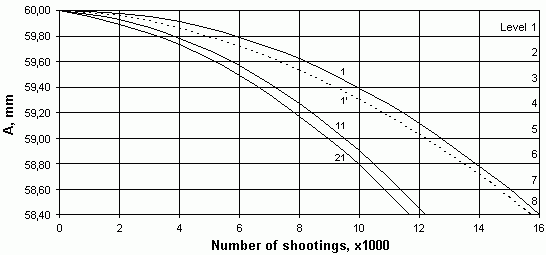 Fig.33. Wear in green sand shooting, results for samples 1, 1', 11 and 21 By analogy with the previous point, the number of shootings in which the samples cross the eight levels is determinated (Table 10). Then with the multiplication of the coefficients K1-8 (Tables 4 and 5) with the corresponding values of Table 10 is defined one more limit N of wear-resistance for the non-participated in the shooting compounds (Tables 11 and 12). The regression equations for N are shown in Table 13. Table 10
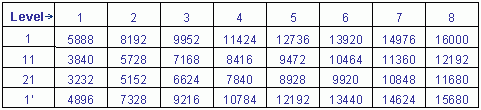 Table 11
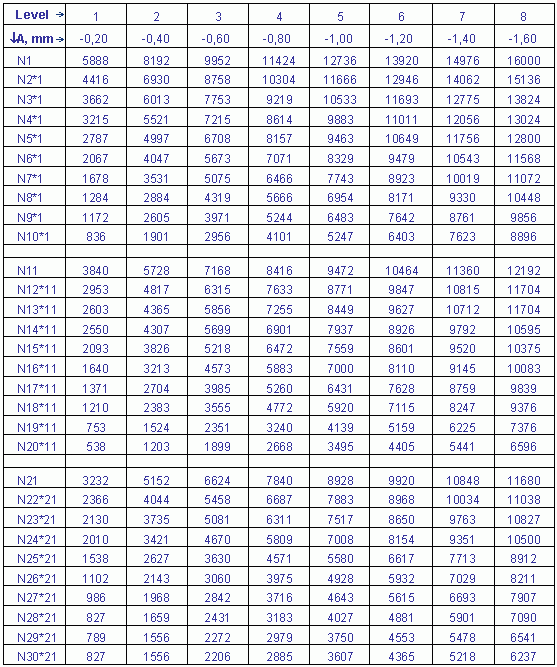 Table 12
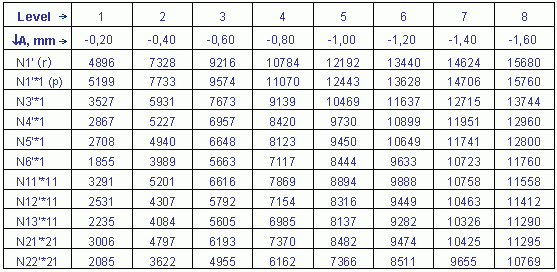 Table 13
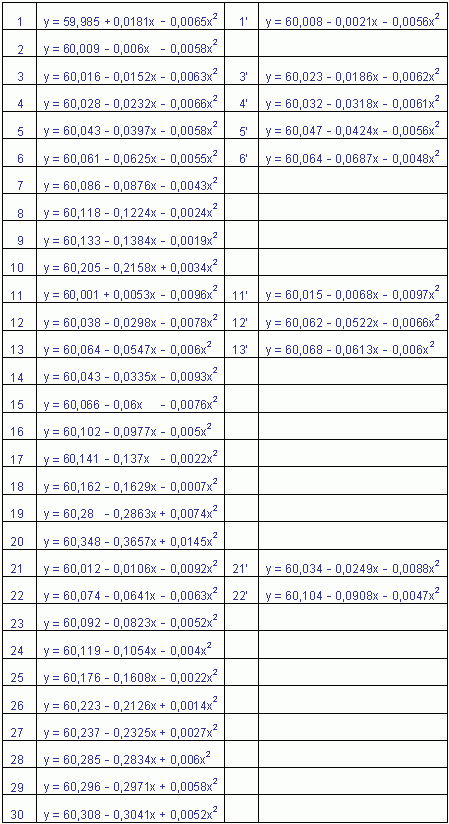 The limit N is defined after the impact of green sand, using a moulding method with strong abrasive effect on the patterns, and position of every sample directly under the respective shooting hole. So, the limit N is a minimal and really achieved wear-resistance. Here is assumed that the influence of the moulding mixture composition is weak, and the wear in shooting is bigger than in the pressure or other moulding methods. When the limit N is achieved, the control over the patterns has to be increased due to the expectations for an eventual their repair or change. Thus, the limit N is more useful for the practice than shown data in the literature. The limits n and N of the representative compounds are defined more slowly than the rotation in sand, but once done, the data serve for determination of wear of great number of compounds without their test shooting. « « « previous page next page » » » |