5.4. Analysis of the results for wear test
- An adequacy check
In the results processing with Advanced Grapher 2.11 and
StatGraphics Centurion polynomial regression is used. The routine comparison between the second power polynomial equations from Tables 9 and 13 with
linear or other type equations is done. It shows minimum Standard deviation and maximum R-squared for the found polynomial regression model. With help of further procedures it my be said that in corresponding
degree of freedom and 99% confidence level, the regression equations of the representative compounds have adequate relationship with the experimental data.
- A check for the approach accuracy
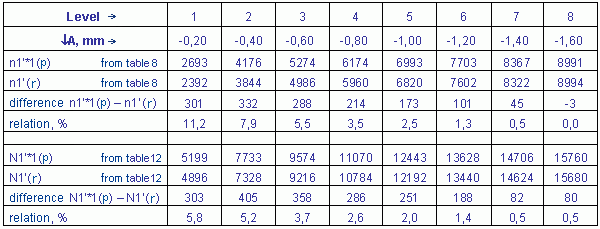
For the determination of the approach accuracy the comparison is done between the values for the real achieved wear-resistance limits
of compound 1': n1'(r),
N1'(r), and its computed (prognosticated) limits
n1' *1(p),
N1' *1(p). The percentage relations are shown in Table 14. It is visible the
prognoses exceed the real wear-resistance. For the guaranteed limit n these differences serve as an information only, because
n is passed by all compounds compulsory. On the average three per cent for the minimal limit of wear-resistance N, it
is assumes that deviation is acceptable for the practice. So, the approach accuracy is within the range of -3%.
Table 14
- A comparison between patterns made in vacuum-sealed sand moulds and plastic moulds
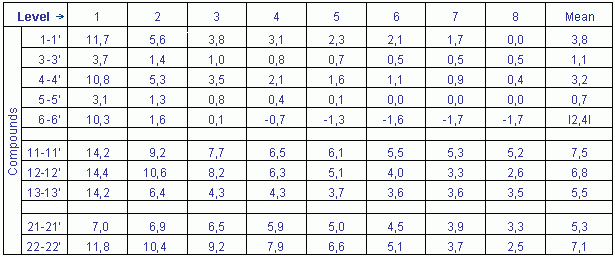
Using the more wide test findings from the rotation in sand (Tables 2 and 3), in Table 15 are presented the percentage differences
between the compared samples. The wear-resistance of the samples by vacuum moulds is better in comparison with the samples made in
plastic moulds. The defined average is 4%. That value is near to the approach accuracy, and it is accepted here as non-essential. It
is seen as well, in the initial levels the differences are bigger and they decrease gradually to the insignificant 1%. The reasons
for that are in the forming of surface layer of the resin pattern in the different moulds and their different surface roughness in
the beginning of the wear.
Table 15
- The influence of the type, quantity and grain size of the filler over the wear-resistance of the patterns
The type of the filler influences strong over the wear-resistance (Fig.34). The most wear-resistant compounds compared here contain
only one filler in equal relation 2:1 to the epoxy resin AP1. The fixed differences between the Fe-dust, corundum and silica sand
grains ensue from the their status in the abrasion wear. The round sand grains become dislodged from the epoxy resin much more easy
than the fractured grains of corundum, which are overlapped between themselves and the resin. The silica sand has
less hardness than corundum as well. In the wear, the metal
fragments hold comparatively favorable positions in the structure of the working layer, and that is the reason for the excellent
wear-resistance of this kind of compounds.
 Fig.34. Wear in
rotation in sand, results for samples 5, 11 and 21 with different type of filler
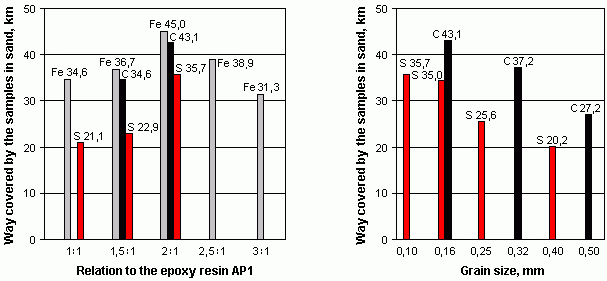
The influence of the quantity and grain size of the filler over the wear-resistance is shown in Fig.35.
In Fig.35-a these
compounds are presented which contain fillers with equal grain size and different relation to the epoxy resin: for the first group 5,
7, 8, 9 and 10, for the second group 12 and 18, for the third group 22, 28 and 29. The results are referred to the last level (-1.6
mm). The optimum relation of 2:1 is fixed, when more and more fragments of the filler counteract to the abrasion flow, and the
quantity of epoxy resin is still enough to ensure strong contact between the grains. Out of the optimum this good balance is broken
and wear grows.
In Fig.35-b the fillers with different grain size and equal relation to the epoxy resin (2:1) are shown: 22,
23, 27 and 30 (silica sand), and 12, 16 and 19 (carborundum). It is determinated that over 0.16 mm grain size, the wear increases.
The reason for that is simple - when the more coarse grains become dislodged from the epoxy resin, they form small pits, the resin
is removed quickly there and the size in this area decreases faster.
a)
b) Fig.35. The influence of the quantity (a) and grain size (b) of the filler
Fe-ferrum dust; C-carborundum; S-silica sand.
- Transformation into dimension ranges of standards or according to customer requirements
The benefit from the described wear research is that the test findings are able to refer to the wear of real resin patterns in their
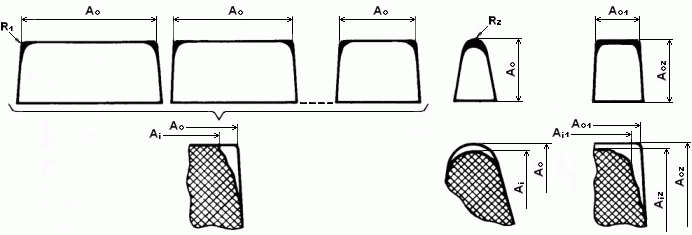
exploitation. When the selection of a determinative dimension (which defines the time of change of the pattern when it will pass
under the allowable limit of accuracy) is made (Fig.36), it is easy the transformation of all equations from Tables 9 and 13 into
dimension ranges of international / national standards or customer requirements. For example, for
EN 12890:2000 [39], n and N can be computed for all patterns in
nominal dimension range from 30 mm up to 4000 mm for the classes (quality categories) K1 and K2. It is the same
for GOST 11961-87 [40] for its nine classes. But in the
last reckoning, how the experimental data for n and N will be used, or the same, what kind of dimension levels will be
chosen, the manufacturer of castings will decide.
a)
b)
c)
Fig.36. A scheme for selection of a determinative dimension (A0, A01 or
A02),
situated horizontally (a), vertically (b) or mixed (c, the smaller size is the determinative)
Ai-the determinative size in the wear; R1-pattern rounding; R2-
rounding in casting construction, R2>>R1.
- Some points for the research development
In this research for wear-resistance of the resin patterns were comprised only a part of factors which influence on the interaction between the equipment and the moulding (core) mixtures. By reason of that,
some notes follow for an eventual continuing of this study in co-operation with other researchers who work in this area:
- The influence of the different machine moulding methods on
the patterns wear is left open. The power of the abrasion impact on the patterns, particularly when the combination of methods is used, is disputable and on these lines the respective investigation may be
done;
- Although it is presupposed here that the different percentage of bentonite, coal dust, etc., and moisture of the moulding sands have a weak effect on the patterns wear, and
it will be probably in the limit of prognostication accuracy (-3%), some kind of research work in this area will be useful for the specifying of the minimal limit of wear-resistance N. What is the
situation in the self-hardening mixtures it is an open question, and a realization of similar investigation would be more interesting;
- If the present wear research is of interest to the manufacturers / companies
specialized in the research, development, and custom formulation of epoxy, urethane or other compounds for foundry patterns and
tooling, and they would give their support, it should be facile to continue this study with wear test for their products;
- The wear research development have to include the metal patterns compulsory. It is not a problem one new test
with samples made of different alloys in rotation in sand with use of the accessible everywhere in industry usual drilling machine
and simple additional equipment. Then the obtained results will be compared to these found in other investigations. It is possible
the input of correction coefficients for making equal the different experimental data. Next, the more slowly shooting tests with use
of one/two metal sample(s) unavoidable will follow, and finally the limit of wear-resistance N for variety of pattern alloys
will be found. Thus, the eventual work in co-operation will give positive results for the practice;
- The prognostication of the maximal limit of wear-resistance is fairly difficult for the present, desirable as
it is. The observations in practice show that the maximal limit ranges are quite much and accidental circumstances have influence
often. Naturally, after a serious analysis of these circumstances and accumulation of more experimental data in some specific
conditions, the range of the maximal limit of wear-resistance can be defined.
« « « previous page
next page » » »
|